Showing posts with label writing. Show all posts

Wednesday, April 15, 2015

My 15 minutes, one year later

My latest column for Inside Higher Ed updates my viral essay from March 2014 about the job market, and asks us to use a bit of Rawls to think about our fate:
And for those of us who do (or will, in my case) have the privilege of working as part of an increasingly rare model that supports our activity as researchers, I have increasingly found myself thinking about what we do and do not deserve, in the manner of the philosopher John Rawls. For Rawls, we cannot possibly deserve our lot in life. This is for many reasons: our skills and attitudes depend on accidents of birth and parentage, for example. More fundamentally, the qualities that we happen to possess are (or are not) valued in certain ways by our particular social arrangement at our particular point in time.
Rawls, famously, suggests that we should design a just society from behind a veil of ignorance, not knowing which position in it we will occupy after our birth. Under these conditions, Rawls thinks, we would grant everyone basic rights, and those inequalities that exist would exist only insofar as they benefited those least well-off. It would be hard to argue, looking only at the system of higher education employment that we have today, that it would meet any kind of Rawlsian standard of justice.
Those of us who have had good fortune to be on the tenure track need to be humble about our luck. We have indeed worked hard for our position, so it can be difficult to feel that we don’t deserve it. But the number of astonishingly talented people who also deserve what we have should shame us from such feelings. We are not behind a veil of ignorance, and we cannot build a new order from scratch. But we should make sure that we are attentive to ways that we can use our positions to improve conditions for those who are least well-off. We cannot deserve our privilege, and they deserve no less.

Thursday, March 05, 2015

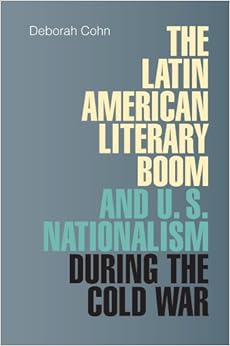
Review of Deborah Cohn's "The Latin American Literary Boom"

A review I wrote of Deborah Cohn's The Latin American Literary Boom and U.S. Nationalism during the Cold War that will appear in the journal The Latin Americanist.


If the search for the great (North) American novel goes on, the great Latin American novel was thought discovered in 1970. That was the year that the English translation of Gabriel García Márquez’s One Hundred Years of Solitude appeared and became a sensation in the English-speaking world. It was the second work by a Latin American writer to make the New York Times bestseller list (after Jorge Amado’s Gabriela, Clove and Cinnamon), and it represented the height of the “boom” in Latin American letters. The literature of the boom generation, for good and for ill, continues to provide readers from around the world with metaphors and points of reference for understanding Latin American politics, society, and history. But, as Deborah Cohn argues in this subtle and rewarding book, the boom happened neither precisely by accident nor by design. It was the complex result of multiple factors, including the work of Spanish publishing houses and literary agents, the solidarity of a small group of talented Latin American writers, the international appeal of the Cuban Revolution, and the Cold War politics of institutions and foundations in the United States.

It is the U.S. Cold War politics of the boom that are the primary subject of Cohn’s book, and they form a particularly rich vein for thinking through problems of cultural transmission. Most of the authors of the boom were resolutely left-wing—sympathizers and defenders of the Cuban Revolution. García Márquez would be famous for his decades-long friendship with Fidel Castro. And many of the novels of the boom explored the decadence of the Latin American bourgeoisie and had clear anti-capitalist interpretations. Yet U.S.-based foundations and organizations with anti-revolutionary Cold War outlooks contributed to making the boom possible. As Cohn writes, “Latin American literature’s circulation in the United States thus paradoxically benefited from both hegemonic and anti-hegemonic forces—that is, from endeavors that stemmed from commitments to anti-revolutionary and revolutionary politics alike.” (4)

To make the argument, Cohn moves through investigations of a number of institutions that had Cold War agendas at work in the background but were made into something more complex than that by their participants. She begins with a description of the McCarran-Walter Act of 1952, which denied visas to foreigners with suspected ties to Communism, a provision that caused intermittent problems for many Latin American writers. The subsequent three chapters cover the meeting of International P.E.N. in New York in 1966, the growth of Latin American literature studies in U.S. universities in the 1960s, the translations sponsored by grants from the Association of American University Presses, and the Ford- and Rockefeller-funded Center for Inter-American Relations (CIAR). The foundations that sponsored these organizations had Cold War objectives—P.E.N. even received some money from CIA fronts.

But in all cases, Cohn weaves complex arguments about the consequences of institutional action, seeing less capacity for ideological control than previous scholars who have examined related topics. The P.E.N. meeting, for example, was a key moment for various Latin American writers, many of them on the left, to meet each other and consolidate the connections that sustained the “boom” as a community. And the CIAR, similarly, promoted left-wing writers and perspectives. In Cohn’s words, “Cold War efforts to neutralize the Communist threat motivated public and private support for the cultural production of a region of great political interest to the United States, creating a space for authors associated with the rising tide of Marxism in Latin America and, by extension, for the expression and dissemination in their works of the ideology that the state was trying to eradicate.” (149)

This is an admirably subtle, and, in my view, convincing argument. But perhaps it is not as surprising as it first appears: both the Ford and Rockefeller foundations were going through politically progressive moments in the late 1960s and 1970s, and practiced some “self-criticism” regarding their sponsorship of earlier “Cold War” projects. Emir Rodríguez Monegal, who edited the magazine Review for CIAR for a time, was fresh off of the exposure of the CIA connections of his previous effort—the infamous Mundo Nuevo—and was eager to demonstrate that he had been an independent socialist all along. And it is not clear that the “boom” literature would always read to North American audiences as “Marxist”—as Cohn points out, modernist literary techniques that were widely used by “boom” writers like Gárcia Márquez were associated with anti-Communist politics in the United States, though not in Latin America. But Cohn’s book is an important and rewarding study that should be of interest to scholars from multiple disciplines, and even to those outside Latin American studies who work on Cold War institutions. She has succeeded in making the politics of the boom simultaneously more complex, and more intelligible.

Thursday, November 06, 2014

Review of Phillip Deery's "Red Apple"

I did a review of Phillip Deery's new book "Red Apple" for the Australasian Journal of American Studies.


In the absence of any objection, I'll post the review below.


Red Apple. By Phillip Deery, Fordham University Press, New York, 2014, pp. xi + 252.

Few areas of historical scholarship are as contentious as that of American Communist history, for the questions that it seeks to answer are still politically charged. How much of a threat was Communism to American society, and what kind of response was justified as a result? Scholars run the risk of being seen as apologists for Stalinism on the one hand, or for McCarthyism on the other. The great contribution of Red Apple is to show the value of going small to address these big problems: in five tight and partially self-contained chapters, it uses intimate portraits of individuals to give some texture to the period of the early Cold War. The result is a careful and balanced history that shows us how lives were shaped by the politics of the era.

Each of the five chapters in Red Apple stands on its own, but there are some unifying themes. Each takes place in the city of New York at the dawn of Cold War repression, from 1945 through to the early 1950s. The introduction states that the book is about ‘the effects of McCarthyism,’ although this is truer of some chapters than others. [1] The first three chapters are effective, though not necessarily unsurprising, accounts of anti-Communist repression. The first chapter deals with the case of Edward Barsky, a surgeon at Beth Israel Hospital and member of the Joint Anti-Fascist Rescue Committee, a body created in 1942 to aid Spanish Republican refugees then in France. The JAFRC came to be seen by the FBI and other agencies of the U.S. government as a Communist ‘front,’ and members of its executive committee, including Barsky, were held in contempt of Congress for refusing to disclose their donor lists. Barsky served his prison term, only to find on release that his medical license was not renewed. The second chapter concerns the well-known Communist writer, Howard Fast, who was also jailed as a member of the board of the JAFRC and similarly found opportunities closed to him after his release. The third chapter deals with the less known cases of two professors at New York University, Lyman Bradley and Edwin Burgum, who were fired from NYU after invoking their Fifth Amendment rights before Congress. Of this group, Fast and Burgum were members of the Communist Party, but Bradley and Barsky were not. Yet they were all criminals in the eyes of the government, and, in a climate of McCarthyism, their troubles extended to their relationships with private institutions. These three chapters nicely illustrate the manner in which different government and private agencies worked “together,” even without coordination, to punish those who were perceived as a threat to national security because of their political commitments.
          
The final two portraits, of the composer Dmitri Shostakovich and the lawyer O. John Rogge, are somewhat different in tone and composition. (They are based on excellent articles that have appeared in American Communist History and Cold War History, respectively.) These are not straightforward cases of McCarthyist repression, but instead chronicle the difficulties that the Cold War climate created for independent thinkers. As a Russian, Shostakovich would seem an outlier among the book’s major figures, but he appeared in New York as part of the Cultural and Scientific Congress for World Peace, better known as the ‘Waldorf Conference’ of 1949, at the behest of Stalin. (‘Peace’ became a major theme of Soviet propaganda during the early Cold War, though Deery argues that the Waldorf Conference was only partially organized by Communists.) There, Shostakovich had to engage in humiliating self-criticism he did not believe in order to safeguard his own life and that of his family. O. John Rogge, meanwhile, was the JAFRC’s lawyer, concerned in the late 1940s with what he saw as creeping fascism in the United States, and also a frequent guest at the Soviet-aligned Peace events. Yet he was also an independent thinker, and generally the only delegate at ‘Peace’ events who would criticize both the U.S. and the U.S.S.R. (instead of only the former) for their belligerence. In 1950, Rogge made an open break with the Soviet peace groups and formed his own Independent Americans for Peace. He was seen as a traitor by the Communists but not fully trusted by the professional anti-Communists, and he met with little success. In addition to advancing what little is known about the Soviet-aligned Peace movement, these two chapters show thoughtful individuals trying to engage with the ethical dilemmas of the early Cold War, and will be of particular interest to historians of the period. They should also be useful in the classroom, where they will give students much material to use and think about.

The virtues of the book’s rather narrow focus do also entail some limits. The research is thorough and comprehensive but perhaps not expansive, drawing extensively from New York University’s Tamiment Archives and from FBI files that the author obtained through Freedom of Information Act requests. The sources are perfectly appropriate for a study of post-war repression, but they can’t contain any great revelations of Soviet thinking or action. And though the book does not aim to be a comprehensive look at the phenomenon of McCarthyism, all of the major characters are white, male professionals.

Yet taken together, the multiple biographies of Red Apple make an important argument. There really were Communist ‘front’ organizations, but, as Deery puts its, the idea of the Communist ‘front’ is ‘problematic, not axiomatic.’ Some were more tightly controlled than others, and organizations like the JAFRC were ‘consistent with, but not rigidly determined by the doctrines of party leaders in New York and Moscow.’ [12] Deery’s is not an argument for the equivalence of Stalinism and McCarthyism: he makes plain that, of all the characters, only Shostakovich’s life was in danger. Dissent in the United States did not mean death. Yet these well-drawn portraits serve as a kind of existence proof: these lives were damaged by McCarthyist anti-Communism, and no one was made safer for it. That in itself is an important result.


PATRICK IBER
University of California, Berkeley


Friday, October 24, 2014

How to Treat Adjuncts

My latest on issues in higher education is up, on the subject of how to treat contingent faculty with respect.
It used to be the case that non-tenure-track faculty were assumed to be inferior to their tenure-line colleagues. These days, however, jobs have become so scarce in many fields that one’s position in the academic hierarchy is largely an accident of birth. One could probably instantly create a new university that would rival the world’s best simply by hiring from the pool of the un- and under-employed.
Suggests for best practices, at the link. I want to hasten to emphasize that I myself feel I have been generally well-treated, and that some of the these practices are based on things I have experienced.

Wednesday, June 11, 2014

In which I read David Brat's dissertation so you don't have to

By a series of improbable near-coincidences, I happened to be looking at the dissertation of David Brat today, on the day after he defeated Eric Cantor in the Republican primary. Under the circumstances, I wrote a review of the dissertation, which is being featured by Washington Center for Equitable Growth.
In defeating House majority leader Eric Cantor in his Republican Party primary, Tea Party-identified David Brat has surprised the political world—including Eric Cantor, whose pollsters assured him he had a comfortable lead. (It has also done some damage to the no-doubt partly-true thesis that the difference between the Tea Party insurgents and the “mainstream” Republican Party had narrowed to the point of insignificance.) Brat defeated Cantor in spite of having only a fraction of Cantor’s power, a fraction of his spending, and a fraction of his allies. Journalists and poltiicos have since been scrambling to learn more about Brat’s thinking. Because Brat is a professor of economics and business at Randolph-Macon College, he has left a large paper trail. Many Tea Party-aligned works—such as W. Cleon Skousen’s The 5,000 Year Leap, a dreadful “history” of the United States as a Christian nation—have been offensive to professional standards. Does Brat’s work fit into that category? It does not.
There is, unsurprisingly, no question that Brat is a conservative. He is to the right of Cantor on most issues. He ran against Cantor’s “corruption,” something that seems consonant with a 2011 essay titled “God and Advanced Mammon—Can Theological Types Handle Usury and Capitalism?” There, he warns of both conservative and liberal hypocrisy and calls for a church that coexists with modern capitalism. (He also writes that he has “the sinking feeling” that someone like Hitler could rise again.[1])  
Brat also administers a $500,000 grant from Branch Banking & Trust Company to teach the “moral foundations of capitalism” at Randolph-Macon, a program that teaches the “free market” principles of Ayn Rand. Brat says that he himself is not a “Randian,” though he says he has been influenced by her works and her perspective.[2] (Rand, of course, was an atheist who thought that belief in God was irrational. One reasonable hypothesis would be that Brat shares Rand’s views of capitalism, but doesn’t accept the anti-religious elements of her worldview.) In an interview in 2010, Brat asserted that “[t]he latest in economic research shows that ethical ideas may matter just as much as traditional economic variables in generating long-run economic growth.”[3]
His works make clear that the intersection of religion and capitalism has long been a matter of interest and concern. And though the published work mentioned above shows no signs of meeting high academic standards, he did earn a Ph.D. in economics in 1996 from American University. His dissertation was called “Human Capital, Religion, and Economic Growth,” and situates itself in the large debate about why some countries are rich and some are poor. Like many dissertations in economics, it is split into three semi-related chapters, at least some of which were later published as journal articles. 
What ties the dissertation chapters together is an interest in the stock of total social knowledge within nations. Brat believes that this aggregate “research and development” capital does a great deal to explain the differences between rich and poor nations: the more, obviously, the better. 
The first chapter of his dissertation is concerned with “[Research & Development] Spillovers and International Convergence,” and focuses on R&D “spillovers” from those that do the research to those that don’t, and finds that these spillovers contribute to the convergence between rich and poor economies. It also argues that the effect of research and development capital is stronger than the effect of human capital, defined in a limited way as investments in secondary education. The second chapter of the dissertation, “Inequality among Nations,” examines changes in inequality between 1960 and 1988. He finds that global inequality worsened over that period, and attributes the differences to R&D investment. In the absence of “spillover” that he explored in Chapter 1, he argues, inequality would be even worse. 
But why, he asks at the end of the chapter, are human capital inputs such as scientists so unevenly distributed throughout the world? It’s a question that he addresses in the third chapter of dissertation, which, by appearances within the text and also given his subsequent career, seems like the most personal. (It also takes up about half of the pages of the dissertation.) In chapter 3, “Science and Religion in the 19th Century,” Brat contributes to a debate in historical sociology that stretches back to Max Weber about the role of religion in economic growth. (Weber, though briefly discussed, is shockingly not cited in the dissertation.) 
Like Weber, Brat believes that Protestantism shapes other social institutions in a way that leads to economic growth. For Brat, however, it is not so much that Protestantism inculcates personal thrift and hard-work, but, more importantly, that it is most compatible with the rise of science. Brat’s hero of economic growth is not the Calvinist farmer or shopkeeper, but the Protestant scientist. 
The chapter examines the rise of scientific education in (Protestant) Germany and England and contrasts it with Catholic France. The basic findings are that Protestantism stimulates scientific production by influencing educational institutions, the organization of the state, and philosophical modes of thinking among scientists. Yet in making the case, Brat is forced to confront the weakness of his own evidence. He catalogues a variety of mild effects attributed to Protestantism on education and the state—and, in particular, in limiting the state in England and allotting a large share of R&D to private industry. (My own view, in my capacity as an historian, is that “Protestantism” is probably not even the right category of analysis for what he is trying to accomplish.) 
Nevertheless, his examination of France leads him to conclude that “Protestantism is not a necessary condition for the advancement of science.” State support, such as existed in France, is sufficient in the short-run, he concludes, but only Protestant-derived states provide the right kind of government structure to provide stability over time, as well as the decentralized environment that can produced good science and research. There is, it must be said, much that is dubious and little if anything that is original in this chapter. Everything is based on the work of other historians and economists; there is no real additional contribution. There is a huge amount of hand-waving in the chain of causation from Protestantism leading to constitutional republics leading to educational institutions leading to good environments for research and development leading to economic growth. It is certainly not the dishonest hack-work of a Skousen, but neither is it scholarship worth much consideration. The conclusion that Protestantism was indeed important for economic growth, though the effect was not large compared to other factors, does show some degree of intellectual restraint. 
But although the pieces are not connected in the dissertation, it is troubling to place the three chapters together. First, because challenging questions for a self-identified “free-marketer,” such as why the state has been so central to the research and development that he believes drives economic growth, are totally unexamined. But more importantly, the question posed at the end of chapter two, about why some countries lack of research and development capital, is given an implied (but not explicit) answer in the third chapter: they have the wrong religion. 
It is easy to see the basis of his interest in the relationship between religious values and ethics and economic growth, even in a nearly twenty-year-old dissertation. But his thinking shows no sign of having grown more complex in the intervening years, and the interview he gave in 2010—in which he states that “ethical ideas may matter just as much as traditional economic variables in generating long-run economic growth” suggests that the modesty of some of the dissertation’s claims has fallen away. 
It has left him, perhaps, with the kind of immodesty and conviction that led him to believe that he could challenge an incumbent Majority Leader—and win.


[1] Reid J. Epstein, “David Brat’s Writings: Hitler’s Rise ‘Could All Happen Again’,” http://blogs.wsj.com/washwire/2014/06/11/david-brats-writings-hitlers-rise-could-all-happen-again/
[2] Eric Lach, “Dave Brat Runs a $500,000 Program to Push Ayn Rand’s Ideas at College,” http://talkingpointsmemo.com/muckraker/dave-brat-bbt-moral-foundations-of-capitalism
[3] David S. Joachim, “A Long Shot so Long, the Tea Party Took a Pass,” http://www.nytimes.com/2014/06/12/us/politics/david-brat-waged-solo-fight-against-eric-cantor.html?module=Search&mabReward=relbias%3Ar 

Monday, June 09, 2014

An Anti-Conference (Interview) Manifesto

Now up at Inside Higher Ed:
The basic argument against the conference interview is straightforward: It imposes considerable costs on the interviewees at a time in their lives when they are likely to be painful to absorb. Professional membership dues, conference registration, airfare, and lodging can easily run to $1,000 or more. Most job-seekers are, naturally, people without secure jobs: graduate students, lecturers, adjuncts, and postdocs. Only the latter (and occasionally the first) are likely to have a support budget from their university to attend the conference, meaning that for most the money will come, in whole or in part, out of pocket. Candidates are sometimes only notified if they will have an interview a few weeks — or, in egregious cases, just a few days — before the conference begins. 
For a graduate student, $1,000 probably equals a month’s salary; for adjuncts and lecturers, it still represents many weeks of labor: money that they will be forced to spend on a kind of grotesque parody of an actual vacation. To this might be added the environmental costs of flying and the difficulties imposed on families, especially those with young children, and you have an institution that would seem to have little to recommend it. If it were not already a tradition, and someone proposed that candidates hoping for tenure-track jobs should have to pay a four-figure dollar amount simply to be eligible for possible employment, it would be considered an unconscionable form of pay-to-play. Yet because it is already the norm, it is accepted.
Read the whole thing here. Also read Rebecca Schuman, who makes a similar case.
Since writing, a friend in Stanford's History Department wrote to tell me that they've voted this year to eliminate conference interviewing. And the positive examples I give in the piece are based on experiences I've had on the job market. Best practices, or at least better practices, are available!

Tuesday, April 01, 2014

Paraíso de espías (Paradise of Spies: Mexico City in the Cold War)

A new text of mine has appeared in Nexos. It updates and extends my academic paper about Vicente Lombardo Toledano, placing Mexico's relative nonchalance about the Snowden revelations in historical context. I argue that Mexico, unusually among Latin American countries during the Cold War, turned the espionage of foreign powers into an asset. It seems to have allowed foreign spies to operate with relative impunity, and therefore gave erstwhile enemies--the U.S., the U.S.S.R., Cuba--a stake in the continuation of the regime in Mexico.


Un ensayo mío acaba de aparecer en Nexos. Aquí los párrafos últimos, que resumen los argumentos principales:

Las redes eran complicadas y seguramente mucho sigue sin saberse. Lo que sí queda claro es que había peligro en la Casablanca mexicana, pero que a la vez —siempre y cuando estuviera bien administrado— también había oportunidad. Para bien y para mal, en América Latina probablemente sólo Costa Rica fue tan “estable” como el PRI en los años que le siguieron a la Segunda Guerra Mundial. Buena parte de aquella estabilidad provenía del autoritarismo suave practicado por el PRI en sus asuntos domésticos. No obstante, casi una excepción en el concierto de naciones, México no tenía enemigo externo. Tolerar los juegos de espionaje de las potencias extranjeras en rivalidad puso a México en una posición de poder: ni Cuba, ni la Unión Soviética o Estados Unidos estuvieron interesados en promover un cambio de régimen en México que pusiera en riesgo el arreglo existente. Lo mismo que sus subsidios a la cuasioposición local que barrían desde la derecha hasta la izquierda (sin significar ningún apoyo), la tolerancia mexicana al espionaje extranjero constituyó una suerte de “subsidio” dirigido a las fuerzas con más potencial desestabilizador en el mundo con el fin de mantenerlas interesadas en preservar al gobierno de México en el poder. La policía secreta mexicana llegó a ser, especialmente en los años sesenta y setenta, un agente de represión en su propio país. Pero, en el ámbito internacional, ayudó a canalizar la intervención extranjera y a administrar los riesgos que aquella era tuvo para México.
A aquellos días de la Casablanca mexicana ya se los llevó el tiempo. El viejo equipo de espionaje fue vendido en los años 1990, la década en que muchas otras cosas se pusieron a la venta. Durante la Guerra Fría, México pareció haber cedido apenas suficiente soberanía a los espías extranjeros que, a fin de cuentas, terminó perdiendo muy poco. Hoy en día los retos a la soberanía estatal vienen desde dentro y son considerablemente más siniestros. La política del espionaje de la Guerra Fría era sucia y corrupta, pero al menos tuvo una chispa de glamour y un ocasional toque de comedia. Fueron malos tiempos aquellos, pero hoy parecen haber sido, quizá paradójicamente, demasiado buenos para durar.

Thursday, March 27, 2014

Juan Rulfo, the Centro Mexicano de Escritores, and the Cold War in the press

So what is Juan Bosch, chopped liver? He got meaningful CIA support, but no one has taken notice. However, the apparent oddity of Juan Rulfo having received CIA dollars, revealed in the essay I recently published with S-USIH, has been making the rounds in the Mexican and international press. Here were some of the early stories.

Then Alejo Schapire of Radio Francia Internacional sent me some interesting follow-up questions, and the interview was published here.

Geney Beltrán Félix did another interview for Confabulario de El Universal, which appeared alongside a translation of the S-USIH essay.

If anyone else in the press wants to talk to me about this, please get in touch through twitter or one of my email addresses, such as [firstname] . [lastname] @ gmail.

Thursday, March 13, 2014

How the CIA bought Juan Rulfo some land in the country

An essay of mine is being featured at the blog of the Society of U.S. Intellectual History. The piece came about as a response to Eric Bennett's fascinating "How Iowa Flattened Literature." I had a few things to say in response, and then a few more, and a few more, and I ended up with this rather long reply. [Update 3/13/2015: This essay has reached the finalist stage of the 3 Quarks Daily politics and social science prize for online writing.]  
Juan Rulfo: mountaineer, author, unwitting recipient of CIA funds


Did the CIA fund creative writing in Mexico? The answer is “yes.” In the second half of the twentieth-century, Mexico’s most prestigious creative writing center, Mexico City’s Centro Mexicano de Escritores, gave writers year-long grants to devote themselves exclusively to writing. Senior authors taught technique and supervised workshops based on the model of the Iowa Writers’ Workshop. Beginning in the late 1950s the CME began to receive funding from the Farfield Foundation, a CIA front, for its publications. Later, more money that was likely from the CIA arrived via the Congress for Cultural Freedom, facilitated by John Hunt, a novelist and CIA case officer who had once taught courses at Iowa. The Farfield Foundation, in the late 1960s, even helped Juan Rulfo, the CME’s prize graduate and teacher, purchase a parcel of land in the countryside.

This February, the Chronicle of Higher Education ran a dynamic and engaging essay, “How Iowa Flattened Literature,” by Eric Bennett, offering both an early look at the findings of his forthcoming book, and a story of how that work came to be.[1] The hook at the beginning of his article is structurally the same as the one used here: “Did the CIA fund creative writing in America?” and the answer is also the same: it is “yes.” The mechanisms and timing were also identical: the Farfield Foundation, John Hunt, mid-to-late 1960s. But in spite of their similarities, putting the two cases side-by-side seems to me not to suggest a reading of the evidence that speaks to the power of the CIA over culture at the height of the Cold War, but rather of the successful mobilization of Cold War politics by program directors seeking to fund necessarily unprofitable work. Put differently, it suggests that institutional writing programs used the CIA more than the other way around.

Before turning to an examination of the evidence, let me begin with an elaborate set of personal disclaimers, for Eric Bennett’s essay arrived at my virtual doorstep like an unexpected gift. The great majority of my childhood was spent in Iowa City, the home of the Iowa Writers’ Workshop. As a young man surrounded largely by cornfields, in a state with many more pigs than people, the Writers’ Workshop provided a serviceable illusion of cosmopolitanism. Important things happened elsewhere, but important writing happened there. I still remember the feeling of embeddedness in a larger cultural universe that came when, at age 14 or 15, I read Iowa teacher Kurt Vonnegut mention the local Sears Roebuck in Slaughterhouse-Five. (Though Bennett’s essay makes one wonder whether this might have been some sort of canny product placement.) Though I left Iowa City some fifteen years ago, as with Bennett, it remains one of my favorite places on earth. But there is more: I have since become a scholar of the cultural Cold War. Bennett’s book, forthcoming with the University of Iowa (!) press—is one that I have been hoping desperately that someone would write. As soon as it is published, it will immediately move to the front of my reading list. If the book in any way resembles the essay to which we now have access, it will be almost everything that we can ask of a book: thoughtful, bold, and entertaining.

But will it also be right? Bennett’s essay is occasionally difficult to pin down; like an anxious bug, its argument seems to change direction just as it is about to be caught. If I have understood it correctly, there are two related central claims. The most important is that something is amiss in the world of literary fiction: a universe that now produces an excess of technically sound work without producing anything that meets the highest standards of what Bennett thinks fiction should be—a literature of ideas. The second claim is that this is not some accident, but that the field of fiction programs was given shape by the politics of the Cold War, including in direct contributions by the CIA to Iowa, the standard-bearer of the MFA army.

These arguments need to be addressed in reverse order, so let me begin with the claim that the hegemony of Iowa in the creative writing ecosystem is responsible for certain deformities in the environment of literary fiction. Bennett’s essay is, in part, a memoir of frustration. Before he did his Ph.D.—where he did the research from which his recent essay was drawn—he too was a student at the Writers’ Workshop. There, he says, there were three types of writing that were possible: 1) modernist fiction à la Eliot, Hemingway, or Munro; 2) “winningly loquacious” writing like Fitzgerald or Cheever; and 3) magical realism. What was discouraged was “postmodernism”; the starting point of fiction was not supposed to be in the world of ideas but in the realms of sense and emotion. This attitude then cascaded throughout the country, for Iowa’s program influenced the formation of all the others: Stanford created the second by hiring Wallace Stegner, one of Iowa’s first graduates, to replicate the model. (And, as Bennett notes, Stegner shared similar impulses, believing that a novelist was “a vendor of the sensuous particulars of life […] not a dealer in concepts.”) The proliferation of MFA programs that came in the years to come bore the Iowa imprint as well, making our era of fiction The Program Era, to borrow the title of Mark McGurl’s book about it.[2] And that landscape resembles the cornfields from which it sprung: pleasantly rolling—not flat—but certainly not dramatically changeable.

This argument has a level of plausibility to it that is hard to dismiss. It seems to have struck a chord with many of my friends with MFAs in creative writing, and it reminded me of a conversation that I had many years ago with my friend and teacher John L’Heureux, who taught writing and English at Stanford, and who warned me years ago against the “puzzle literature” of David Foster Wallace that I found exciting in those days. But there is a slippage in Bennett’s essay that I can’t follow: from a dislike of “cute” postmodern literature at Iowa to an absence of a literature of ideas. The authors that Bennett’s teacher Frank Conroy at Iowa discouraged from serving as models were the “postmodernists” like Barth and Pynchon: “Meaning, Sense, and Clarity” was the mantra. Bennett seems to be arguing that imposing these structural and stylistic constraints make it difficult to write Something Very Important. In a Bourdeauian sense, the “field” of literary fiction has been structured in a way that excludes the kind of work that would be foundational to a literature of ideas. “Texts worth reading,” Bennett writes in the final paragraph of the essay, “worth reading now, and worth reading 200 years from now—coordinate the personal with the national with the international; they embed the instant in the instant’s full context and history.” As an historian and not as a fiction writer, this seems to me perfectly reasonable. But the writers who Bennett signals are coming closest to that standard today, Jonathan Franzen and Marilynne Robinson, are working in a different tradition than Barth and Pynchon.[3] (And, for what it might be worth, Robinson teaches at Iowa.)

Additionally, speaking as a teacher, asking students to attempt to write something that will have value in two hundred years seems like an invitation to total disaster. Bennett wants us to work to produce a great work of ideas: the kind of thing that will come around every half century years or so, summoning the spirit of the age with one hand and asking it to wait with the other. But perhaps the work has already been written; what people fifty and a hundred years from now will find remarkable about our age may well not be what we think it is today. Though some miasmatic version of Bennett’s argument about the influence of Iowa seems plausible, I can’t help but think that even Iowa could not stand in the way of Something Very Important being written, at least over the long run.

But whatever my own doubts might be, this is world to which I cannot speak from experience. Many of my MFA-graduate friends seemed to find significance in Bennett’s piece, as if their exquisitely rendered career frustrations could be likened to a hollow novelty birthday cake out of which had just popped a man with dark glasses and an obvious record of human rights abuses. And to this second point, I can speak with more authority: what does it mean that the CIA funded creative writing at Iowa?

The “smoking gun” is a contribution to Paul Engle of the Iowa Writers’ Workshop from the Farfield Foundation, dated 1967. As Bennett notes, the Farfield Foundation was not an ordinary charitable organization: it was a CIA front.  Its most important task was to provide the public face for the money that to the Congress for Cultural Freedom, the CIA’s major vehicle for the support of anti-Communist artistic and intellectual work during the Cold War. The Farfield Foundation was “in” on the whole thing. Julius “Junkie” Fleischmann, the head of the Foundation, saw himself as doing the CIA a favor. One of the CIA officials who arranged for the money to be transferred described him as one of the many “rich people who wanted to be of service to government…They were made to feel they were big shots because they were let in on this secret expedition to battle the Communists.”[4]

The full scope of CIA engagement with culture is beyond the scope of this essay, but let me be clear that it is not something that I want to defend. Indeed, around the time of Farfield’s contribution to Engel, such activities were becoming (appropriately, in my view), unacceptable. The Congress for Cultural Freedom had arranged to sever its financial relationship with the CIA in 1965; bailed out by a long-term grant from the Ford Foundation that substituted for it beginning in late 1966. The CIA was worried that its actions were close to being exposed (and they were, in newspaper articles in the New York Times in 1966 and in more detail in the magazine Ramparts in 1967). Subsequent actions required that these CIA contributions to cultural and “civil society” groups be wound down; a few of the most valuable properties, like Radio Free Europe/Radio Liberty, were maintained, and most were not and such functions were eventually passed over to quasi-governmental National Endowment for Democracy, created in the 1983. The contribution to Iowa in 1967 comes at the very end of possibility for such a transaction from the CIA.

But what are we to make of it? Here, I think the contrast with the Mexican Writing Center is instructive. The Centro Mexicano de Escritores was founded in fits and starts during the early 1950s; its prime mover was a North American novelist named Margaret Shedd. She was a semi-permanent resident of the Bay Area, and had witnessed Stegner building the program at Stanford, where she sometimes taught extension courses. (In that sense, the Mexican Center is probably the first attempt to internationalize the Iowa model, at two steps of remove.) Shedd’s husband had worked in the U.S. embassy in Mexico, and her boredom led her to formulate plans for a binational writing workshop. As with Iowa, a lot of money in the 1950s came from the Rockefeller Foundation, which provided year-long grants, mostly for Mexican writers but occasionally for some from the U.S. or elsewhere in Latin America, to devote themselves exclusively to their craft. Shedd and others taught much-ridiculed courses in technique, while students met in frequent workshops. The record of selecting promising writers was extraordinary: over its life, graduates of the CME included Juan Rulfo, Carlos Fuentes, Elena Poniatowska, Rosario Castellanos, Carlos Monsiváis, and many others that number among Mexico’s best novelists, poets, playwrights, and essayists.

National security concerns were always present in the motivations of the CME’s foreign funders. The Rockefeller Foundation believed that exchange between North American and Mexican writers would improve relations between the two countries at an important node, making the (implausible) assumption that writers “spoke for their countries.” In 1959, the CIA-front Farfield Foundation began contributing a small percentage of the annual budget—something like 2% of the total. In the early 1960s, the Congress for Cultural Freedom itself grew interested, and paid the salary of Juan Rulfo for at least a couple of years. Rulfo’s lifetime literary output consisted of a celebrated short novel, Pedro Páramo, and a book of short stories, El llano en llamas (The Burning Plain), both finished on CME grants in the early 1950s. He would never publish anything else again. Money from the Congress for Cultural Freedom paid for Rulfo’s salary in the mid-1960s, hoping that he would become a more prominent author to rival famous Communist writers like Pablo Neruda. In the late 1960s, the Farfield Foundation seems to have been persuaded to buy him that plot of land in the country—to give him the peace and quiet to write, of course—something he never did again.

It would be easy, at this juncture, to decry the CIA’s influence over Mexican culture. And indeed, the CME does seem to have had a policy of not admitting Communists in the 1950s. In turn, some on the literary left insulted the “Gringo-Mexican Institute” for its Rockefeller funding, and imagined that Shedd was writing a novel called the Subterranean Penetration of the USA in Mexico. But in the 1960s, when the CIA was providing some of the budget, there were actually several Communist students. Plenty of others who passed through the Center, such as Carlos Fuentes, Elena Poniatowska, and Carlos Monsiváis, remained associated with one variety or another of left-wing politics and certainly did not shy from criticism of U.S. imperialism. The CIA’s manipulations seem entirely wasted: it is very difficult to see any clear relationship between the politics of the Center’s funders and what its literary output. The Rockefeller Foundation wanted Mexico and the U.S. to “understand” each other better; the CIA wanted to boost the profiles of anti-Communist writers. But the naïve Pan-Americanism and anti-Communist both went unfulfilled. After the 1960s, when the Mexican government and private corporations supplied most of the budget, they wanted the Center to produce great writers that would redound to the glory of Mexico. But this too was a failure: it was the years of most compromised foreign funding that produced the best graduates. It seems to me that the CME was a remarkable failure as an instrument of cultural diplomacy, but was, all the same, one of the most important and successful writing centers in the world during its best years. It closed in 2005, and looks to me like a noble monument to success through failure.

What is striking, then, given the parallels to Iowa—where many of the same features were present—is not the influence of the CIA over culture, but the ability of cultural producers to use the politics of the Cold War to further their own endeavors. “[Iowa’s Paul] Engle constantly invoked the need to bring foreign writers to Iowa so they could learn to love America,” writes Bennett. “That was the key to raising money. If intellectuals from Seoul and Manila and Bangladesh could write and be read and live well-housed with full stomachs amid beautiful cornfields and unrivaled civil liberties, they would return home fighting for our side. This was what Engle told Midwestern businessmen, and Midwestern businessmen wrote big checks.” Yes, Paul Engle at Iowa was a Cold Warrior. He accepted money from the CIA, and used the language of the Cold War to earn sponsorship from both local businesses and the state bureaucracy. Just as in Mexico, creative writing in the United States depended on shining the boots of the capitalist class and the state bureaucracy that defended it. But if the effects of this on what was written were minimal, then who, exactly, was using whom?


[1] http://chronicle.com/article/How-Iowa-Flattened-Literature/144531/ The essay is adapted from a somewhat longer essay in a brand-new edited volume: Eric Bennett, “The Pyramid Scheme,” in MFA vs. NYC: The Two Cultures of American Fiction, ed. by Chad Harbach (New York: n+1/Faber and Faber, 2014), 51–72.
[2] Mark McGurl, The Program Era: Postwar Fiction and the Rise of Creative Writing (Cambridge, Mass.: Harvard University Press, 2009).
[3] Additionally, there are clearly graduates of MFA programs who have worked in the “postmodern” tradition. I think, for example, of Chris Bachelder, a graduate of the University of Florida in 2002 and his satire Bear vs. Shark. And also his later U.S.!, a masterful novel of ideas that describes the world’s reaction to the resurrection of the undead corpse of Upton Sinclair—one of the smartest things about the left in the United States that I have ever read.
[4] Frances Stonor Saunders, The Cultural Cold War: The CIA and the World of Arts and Letters (New York: New Press: Distributed by W.W. Norton & Co., 2000), 126.